Fan Out Messaging
Fan-out messaging is a distribution pattern in which a single published message is copied and delivered to multiple independent queues or subscribers, enabling one event to trigger several parallel downstream workflows simultaneously.
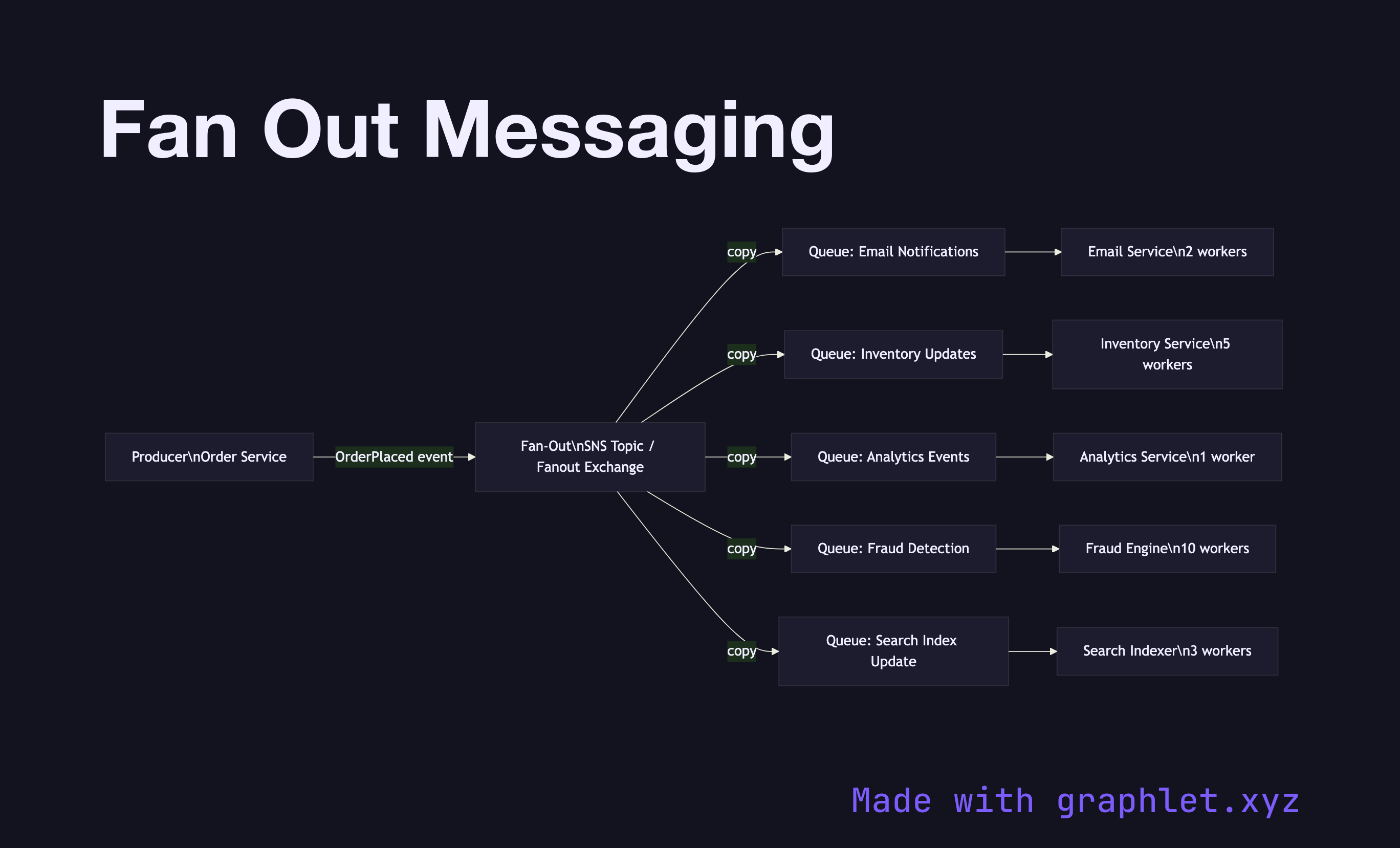
Fan-out messaging is a distribution pattern in which a single published message is copied and delivered to multiple independent queues or subscribers, enabling one event to trigger several parallel downstream workflows simultaneously.
Fan-out solves a common integration challenge: a single event (an order placed, a file uploaded, a user registered) needs to kick off multiple independent processes — send a confirmation email, deduct inventory, update analytics, trigger fraud checks — without coupling any of these processes to each other or to the producer.
The pattern works by inserting a distribution layer between the producer and its consumers. In RabbitMQ, a fanout exchange copies the inbound message to all bound queues. In AWS SNS + SQS, an SNS topic fans out to multiple SQS queues. In Kafka, multiple independent Kafka Consumer Groups reading the same topic achieve the same effect with the added benefit of replay.
Each downstream queue acts as a buffer for one independent workflow. This means the workflows can scale separately: the fraud detection queue can have 10 workers while the email queue has 2. Failure is also isolated — if the analytics service is down, its queue backs up while the email service continues processing normally. Compare this to Competing Consumers Pattern, where multiple workers share a single queue and split the work rather than each receiving a full copy.
Fan-out is the core mechanism behind most Event Driven Architecture implementations: a domain event is the pebble that fans out ripples across an entire system.