Multi Currency Processing
Multi-currency processing enables merchants to charge customers in their local currency while settling funds in the merchant's preferred currency. This improves conversion rates (customers see familiar prices without mental FX math) and shifts the currency conversion cost to a controlled point in the payment stack.
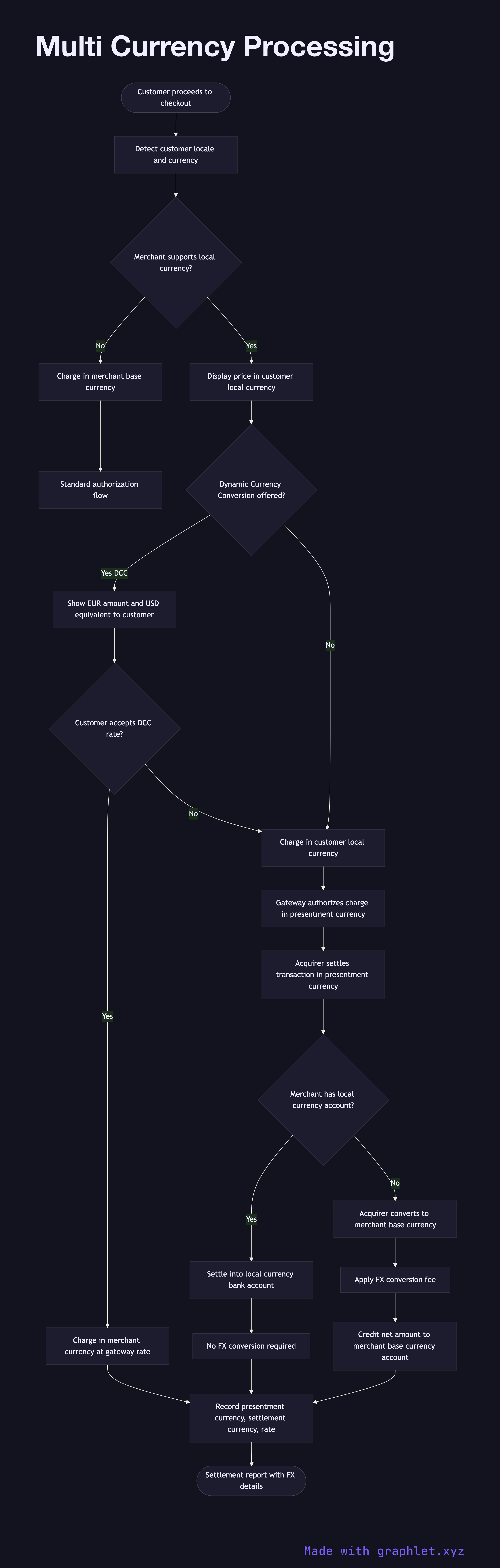
Multi-currency processing enables merchants to charge customers in their local currency while settling funds in the merchant's preferred currency. This improves conversion rates (customers see familiar prices without mental FX math) and shifts the currency conversion cost to a controlled point in the payment stack.
The flow begins at checkout when the merchant's system or the payment gateway detects the customer's likely currency — typically derived from IP geolocation, browser locale, or an explicit customer selection. The merchant must decide whether to present the price in the customer's local currency (presentment currency) or their base currency.
When the customer checks out in a non-merchant currency, the payment gateway processes the charge in the presentment currency. For example, a US merchant (settling in USD) charges a European customer €85. The gateway authorizes the charge against the cardholder's EUR account with the issuing bank.
If the merchant opts for Dynamic Currency Conversion (DCC), the conversion to USD happens at the point of authorization — the customer sees both the EUR amount and the USD equivalent and may accept the gateway's exchange rate (which includes a markup). DCC is controversial because it benefits the merchant/gateway at the cardholder's expense.
Without DCC, the charge is settled in EUR. The acquirer converts EUR to USD at the settlement exchange rate (typically the network's rate on settlement date) and credits the merchant's USD account after deducting a foreign exchange (FX) conversion fee. The merchant's settlement report must track both presentment currency, settlement currency, the exchange rate applied, and the FX fee for accurate Payment Reconciliation.
Merchants processing high volumes in multiple currencies often open local settlement accounts in each currency to avoid repeated FX conversions — settling EUR transactions into a EUR bank account rather than converting to USD, which reduces FX costs and provides natural currency hedging.