Microservice Request Chain
A microservice request chain is the sequence of synchronous service-to-service calls triggered by a single client request in a distributed system — where each service may itself call one or more downstream services to fulfill its part of the work.
A microservice request chain is the sequence of synchronous service-to-service calls triggered by a single client request in a distributed system — where each service may itself call one or more downstream services to fulfill its part of the work.
What the diagram shows
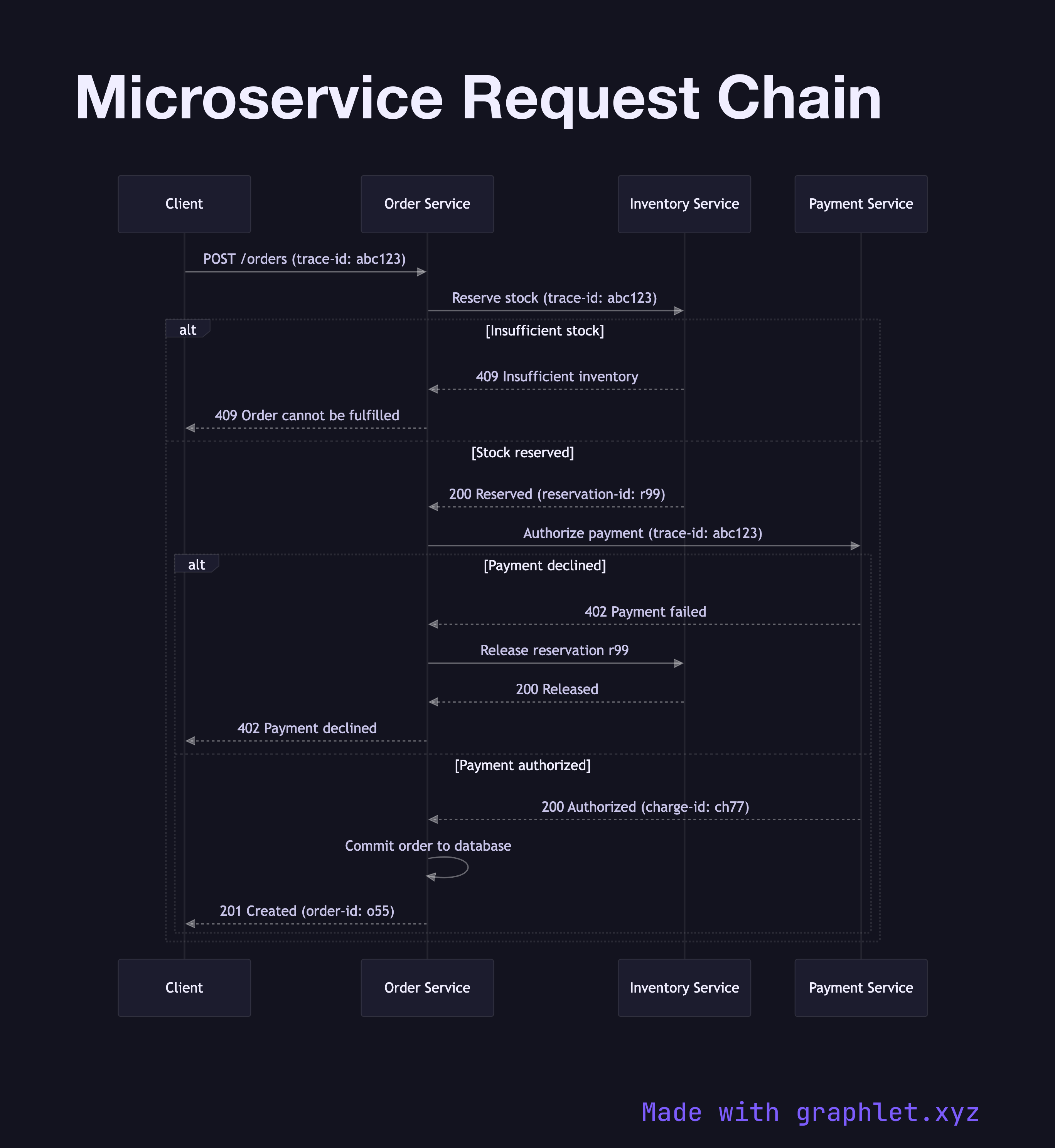
This sequence diagram traces a user-facing request as it propagates through four services: Client, Order Service, Inventory Service, and Payment Service.
The client sends a POST /orders request to the Order Service. To fulfill the order, the Order Service must first reserve stock by calling the Inventory Service. If inventory is insufficient, a 409 Conflict propagates back to the client without ever reaching the payment step. When stock is available, the Order Service calls the Payment Service to authorize the charge. A payment failure triggers a compensating call back to the Inventory Service to release the reservation — a simplified form of the Saga pattern. Only after both downstream calls succeed does the Order Service commit the order and return 201 Created.
Trace IDs are propagated at each hop, enabling distributed tracing tools to reconstruct the full call chain.
Why this matters
Synchronous request chains introduce latency compounding: the end-to-end response time is the sum of all hop latencies. They also create tight coupling — if the Payment Service is down, orders fail even if inventory is healthy. Understanding the call chain visually makes these trade-offs concrete and highlights where Circuit Breaker Pattern or async patterns (see Worker Queue Processing) should be introduced.
For how the gateway dispatches to the first service, see API Gateway Request Flow. To monitor this chain end-to-end, explore Distributed Tracing Flow.