Request Retry Logic
Request retry logic is a client-side resilience pattern that automatically re-attempts failed requests using a backoff strategy, improving success rates for transient failures without overwhelming an already-struggling upstream service.
Request retry logic is a client-side resilience pattern that automatically re-attempts failed requests using a backoff strategy, improving success rates for transient failures without overwhelming an already-struggling upstream service.
What the diagram shows
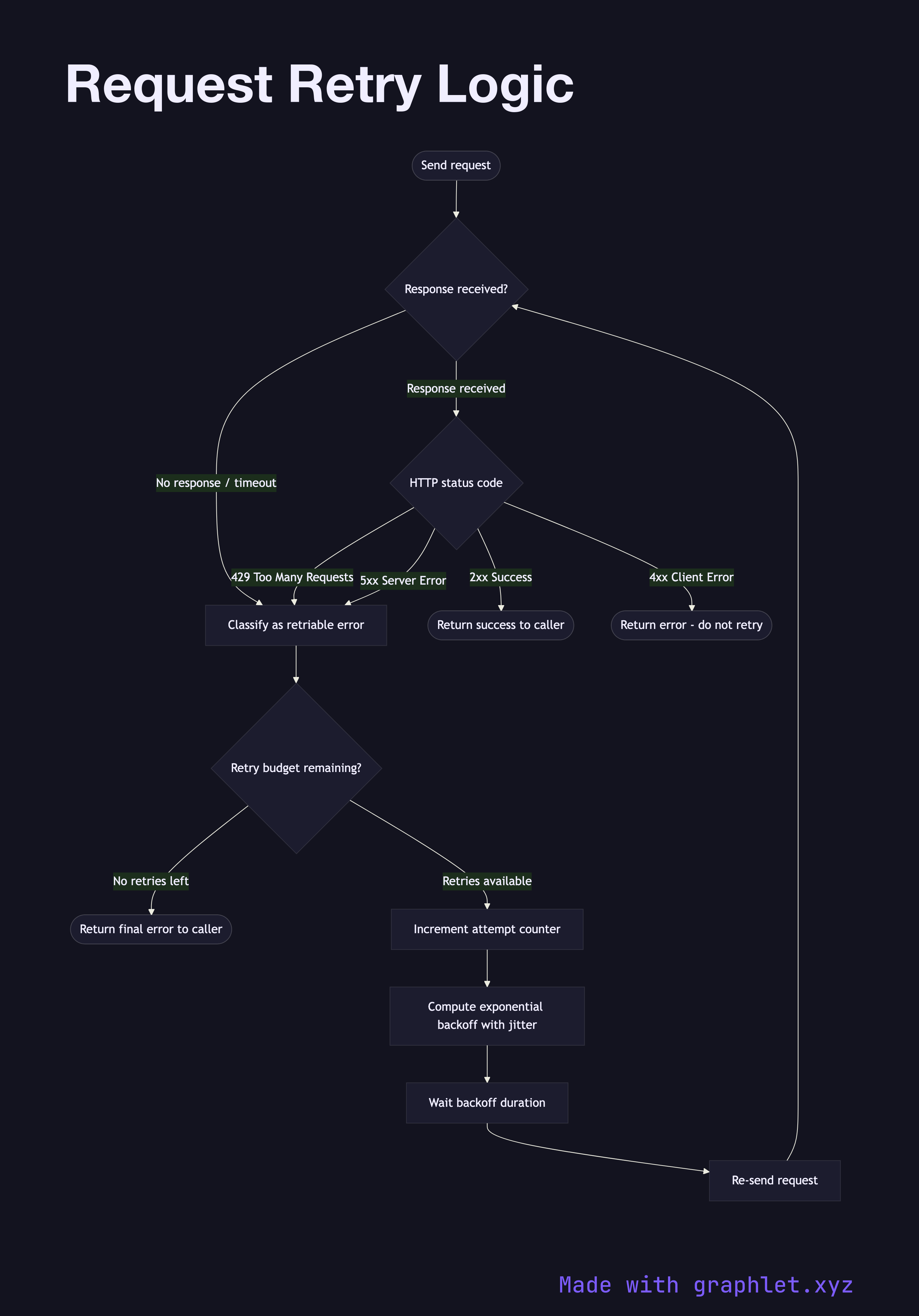
This flowchart models the complete retry decision tree:
1. Send request: the client sends the initial request to the upstream service. 2. Evaluate response: a successful response (2xx) exits the loop immediately. 3. Classify error: not all failures are retriable. 4xx client errors (e.g., 400 Bad Request, 401 Unauthorized, 404 Not Found) indicate the request itself is malformed — retrying it won't help. 429 Too Many Requests and 5xx server errors are candidates for retry. 4. Check retry budget: the client tracks the attempt count against a configured maximum (e.g., 3 attempts). Exhausted retries surface the error to the caller. 5. Compute backoff: the wait time between retries follows exponential backoff — base * 2^attempt — with added jitter to prevent thundering herd when many clients retry simultaneously. 6. Wait and retry: after the backoff period, the request is re-attempted.
Why this matters
Without retry logic, transient network blips or brief service restarts cause user-visible errors that could be silently recovered. Without a backoff strategy, naive retries can amplify load on a struggling service — the opposite of what you want. Exponential backoff with jitter is the industry-standard approach, recommended by AWS, Google, and Netflix in their resilience guidelines.
Retries should always pair with a Circuit Breaker Pattern — once a service is known to be down, the circuit opens and retries are skipped entirely. For webhook-specific retry strategies, see Webhook Retry Strategy. The Rate Limiting Architecture explains the 429 responses that trigger retries on the server side.