Message Deduplication
Message deduplication is the process of detecting and discarding duplicate message deliveries at the consumer side, ensuring that a business operation is executed exactly once even when the messaging infrastructure delivers the same message more than once.
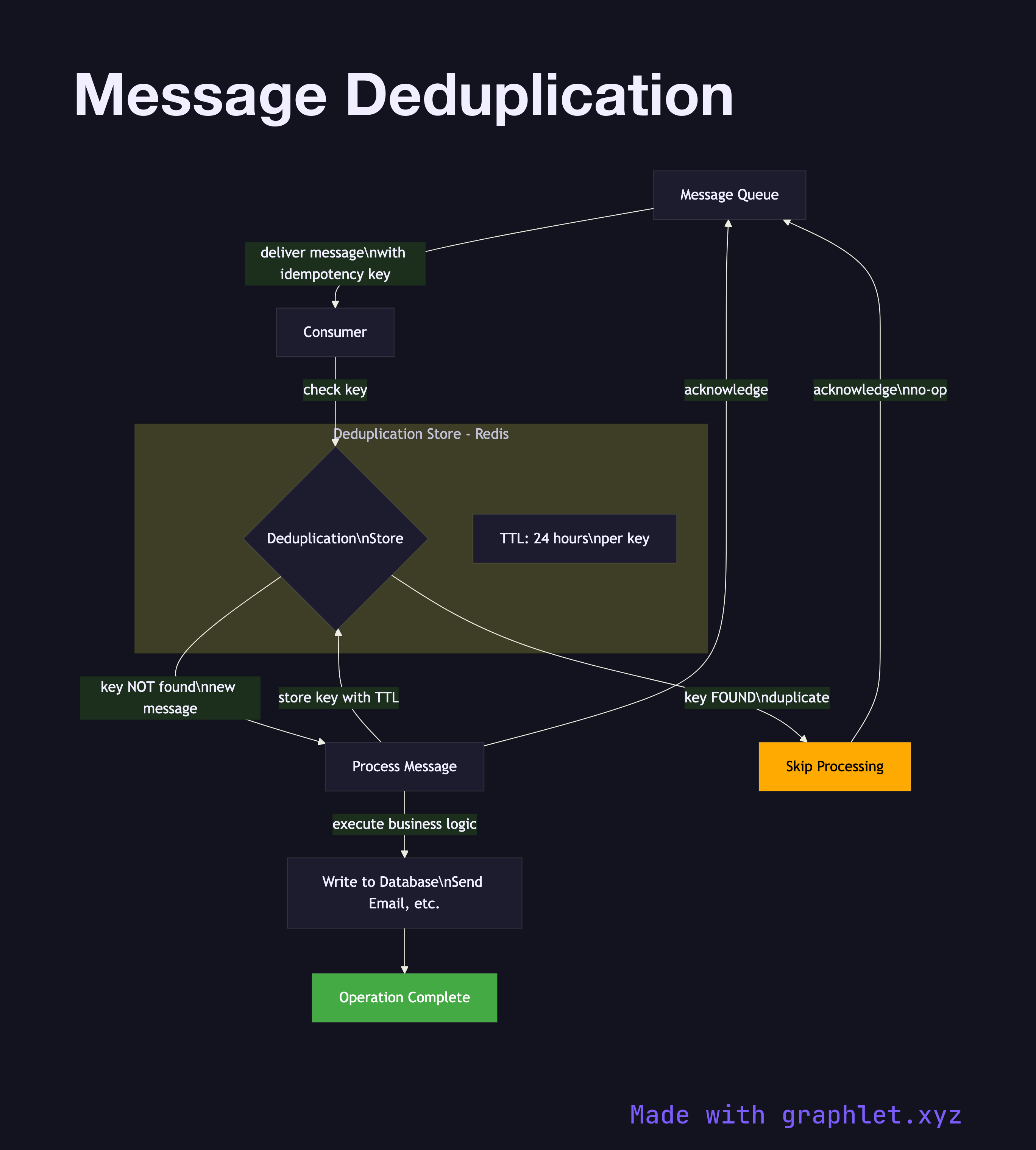
Message deduplication is the process of detecting and discarding duplicate message deliveries at the consumer side, ensuring that a business operation is executed exactly once even when the messaging infrastructure delivers the same message more than once.
In any at-least-once delivery system — which includes most production message queues and event streaming platforms — a message may be delivered multiple times. This happens after consumer restarts (replaying from the last committed offset), after network timeouts (producer retries that succeed on the second attempt), or during rebalances in systems like Kafka. Without deduplication, these duplicates translate into double charges, duplicate notifications, or corrupt aggregate counts.
The standard solution is an idempotency key: a unique identifier embedded in every message at the time of creation (a UUID, or a domain-specific key like payment-{order_id}). When the consumer receives a message, it checks the idempotency key against a deduplication store — typically a Redis set with a TTL matching the maximum expected redelivery window (minutes to hours). If the key is already present, the message is a duplicate and is acknowledged without reprocessing. If absent, the key is written to the store and processing proceeds.
The deduplication window TTL is a critical tuning parameter. Too short and late redeliveries slip through; too long and the store grows unbounded. For stream processors, the Stream Processing Pipeline often embeds deduplication as an explicit stage. In Kafka, idempotent producers (enable.idempotence=true) handle producer-side deduplication at the broker level, but consumer-side deduplication remains the application's responsibility. See Idempotent Consumer for the broader design pattern.