Mobile API Sync
Mobile API sync describes the request-response cycle between a mobile app and a backend REST (or GraphQL) API, including the layers of caching, authentication, error handling, and retry logic that make the interaction reliable over unreliable mobile networks.
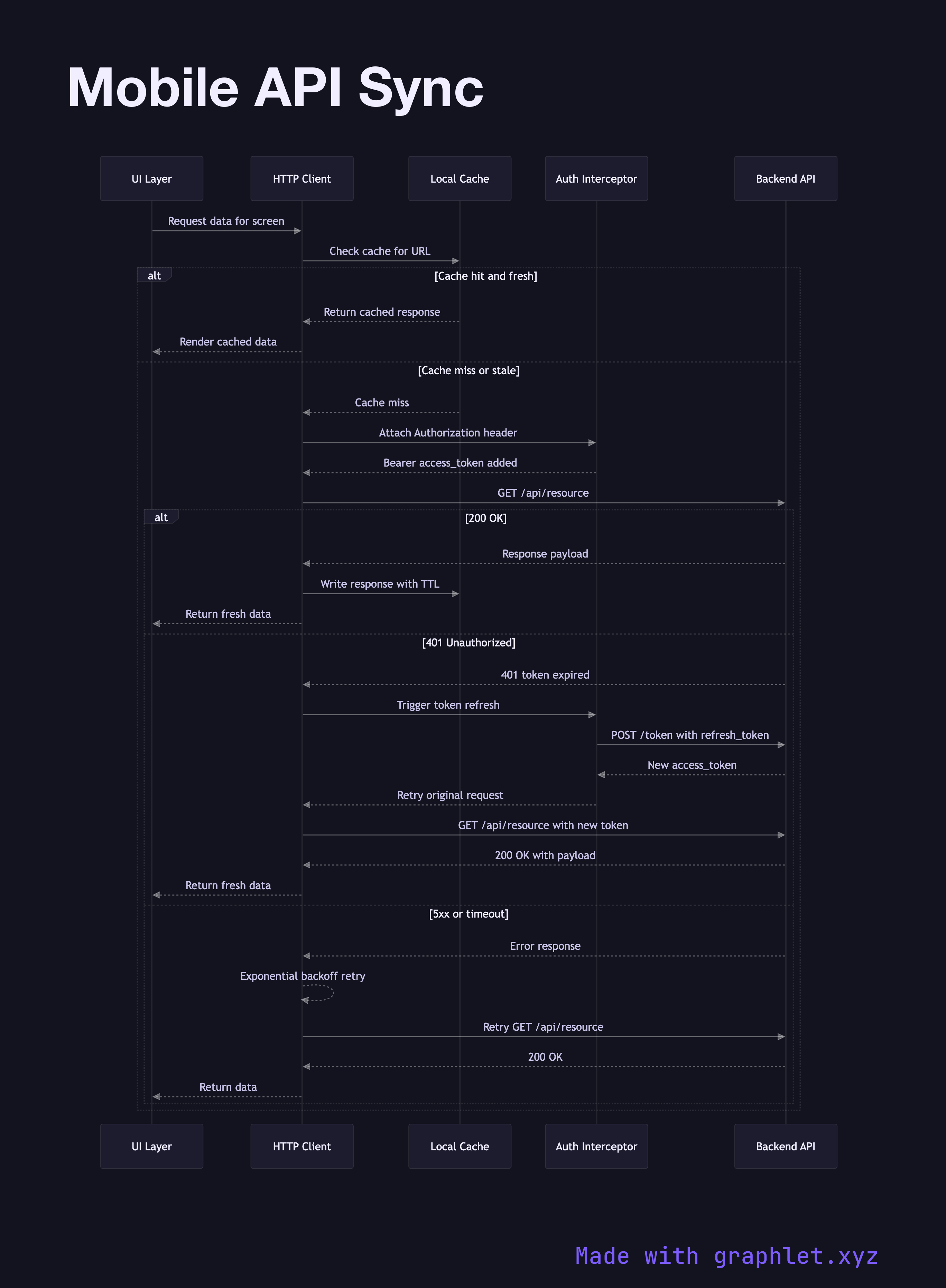
Mobile API sync describes the request-response cycle between a mobile app and a backend REST (or GraphQL) API, including the layers of caching, authentication, error handling, and retry logic that make the interaction reliable over unreliable mobile networks.
Every API request on a mobile client passes through several layers before network I/O occurs. First, an HTTP client layer (URLSession on iOS, OkHttp on Android, or a cross-platform library) checks whether a valid cached response exists for the URL. Cache validity is determined by the Cache-Control headers returned by the server on previous responses, or by an application-level TTL stored alongside the cached data. If the cache is fresh, the response is returned immediately without touching the network.
If the cache is stale or absent, the client adds authentication credentials — typically an Authorization: Bearer header — and sends the request. If the server returns a 401 Unauthorized, an auth interceptor automatically attempts to refresh the access token using the stored refresh token. On a successful refresh, the original request is retried with the new token transparently, without surfacing an error to the calling code.
Transient failures (network timeout, 5xx response) are handled by an exponential backoff retry policy. The client waits an increasing interval between retries — 1s, 2s, 4s — and gives up after a configurable maximum attempt count. If the maximum is exceeded, the error propagates to the UI layer.
On a successful 200 response, the payload is written to the local cache store and used to update the in-memory data model. The UI layer observes these model changes reactively and re-renders only the affected components.
For the offline variant of this flow where the network is unavailable, see Offline Sync Workflow. For cache eviction strategies, see Mobile Cache Strategy.