IoT Command Control Flow
IoT command and control flow describes the sequence of messages exchanged when an operator or automated system sends a command — such as "set thermostat to 22°C" or "open valve for 30 seconds" — to a remote device, including authorization checks, delivery acknowledgement, execution confirmation, and timeout handling.
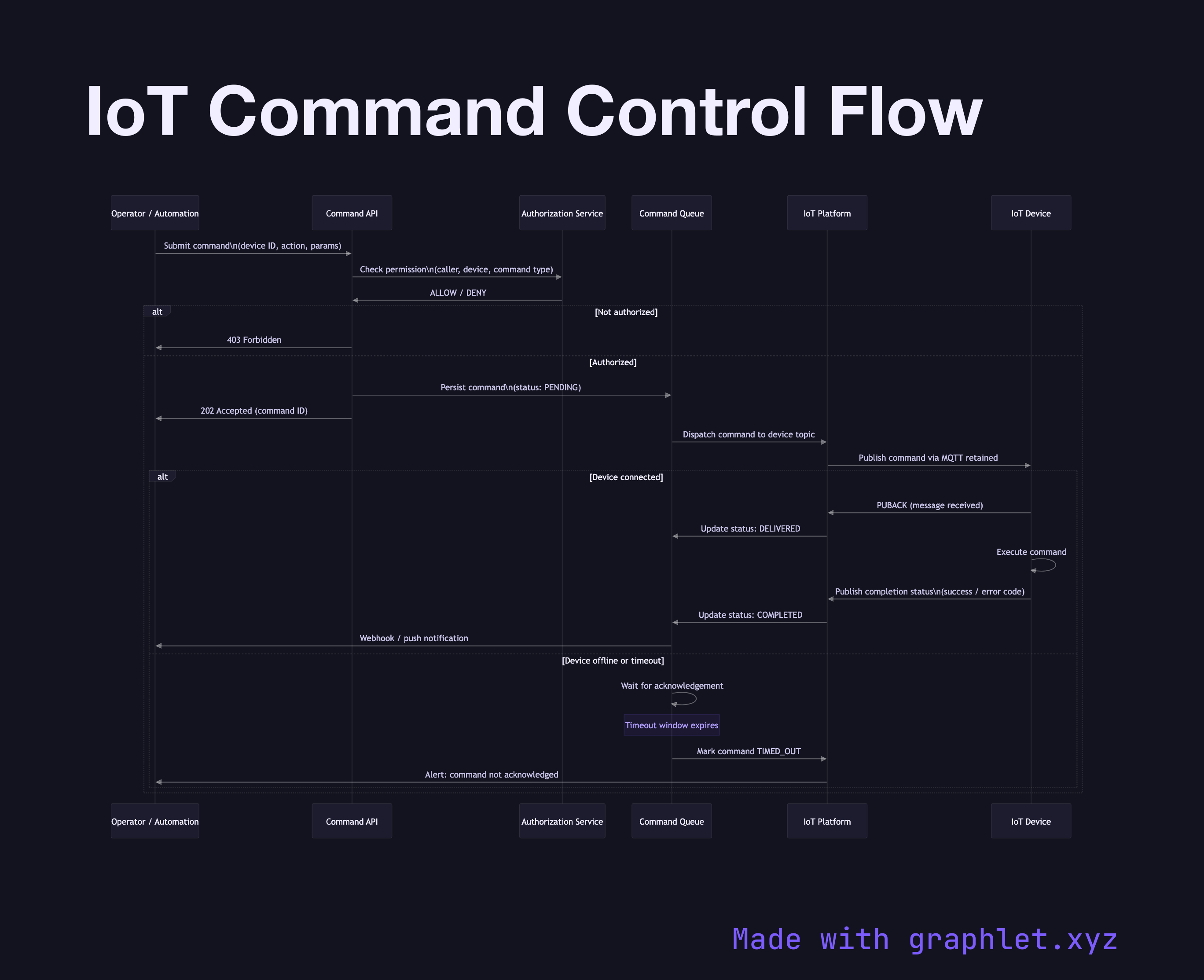
IoT command and control flow describes the sequence of messages exchanged when an operator or automated system sends a command — such as "set thermostat to 22°C" or "open valve for 30 seconds" — to a remote device, including authorization checks, delivery acknowledgement, execution confirmation, and timeout handling.
Reliable command delivery is harder than it appears because IoT devices are frequently offline, on intermittent connections, or slow to process commands due to constrained hardware. A well-designed command flow must handle all of these cases without losing commands or sending them twice.
Commands originate from one of three sources: an operator acting through a management dashboard, an automation rule firing in response to a sensor event, or an external system integrating via API. All three paths route through the same command API, which enforces authorization — does this caller have permission to send this command type to this device?
Authorised commands are stored in a command queue in the cloud device shadow or job store before delivery is attempted. This persistence means commands survive transient device disconnections. The cloud platform publishes the command to the device's subscribed MQTT topic. If the device is connected, it receives the command promptly and publishes an execution acknowledgement back to the platform. If the device is offline, the retained message waits and is delivered on next connection.
The device executes the command and publishes a completion status — either success with the new state, or failure with an error code. The command queue marks the job complete. If no acknowledgement arrives within a configurable timeout window, the platform marks the command as timed-out and raises an alert. Operators can inspect failed or timed-out commands and choose to retry or escalate. For the authentication layer underpinning this channel, see IoT Device Authentication. For firmware update commands specifically, see IoT Firmware Update Flow.