ARP Resolution
ARP (Address Resolution Protocol, RFC 826) is the protocol used to map a known IPv4 address to an unknown MAC (Media Access Control) address on a local network segment, enabling link-layer frame delivery.
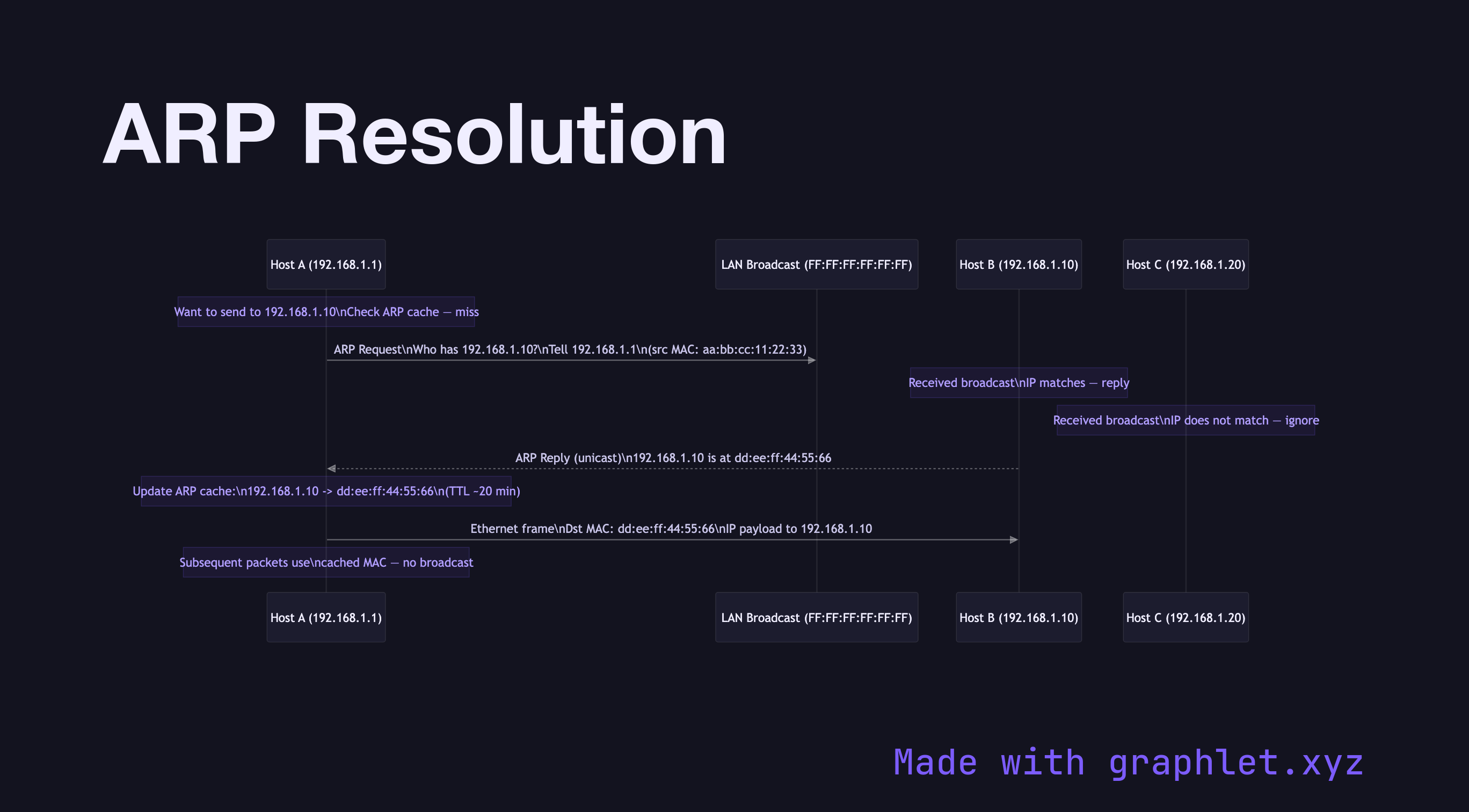
ARP (Address Resolution Protocol, RFC 826) is the protocol used to map a known IPv4 address to an unknown MAC (Media Access Control) address on a local network segment, enabling link-layer frame delivery.
IP routing gets a packet to the correct subnet, but Ethernet (and most link-layer technologies) uses MAC addresses for actual frame delivery between devices on the same network segment. ARP bridges this gap.
When ARP is needed: When device A wants to send an IP packet to device B on the same subnet, it needs B's MAC address to construct the Ethernet frame. If A doesn't have B's MAC in its ARP cache, it must perform ARP resolution.
ARP Request (Broadcast): A sends an ARP request frame to the broadcast MAC address (FF:FF:FF:FF:FF:FF). The frame says: "Who has IP 192.168.1.10? Tell 192.168.1.1." Every device on the segment receives this frame.
ARP Reply (Unicast): Only the device with the matching IP responds. It sends a unicast ARP reply directly to A: "I have 192.168.1.10; my MAC is aa:bb:cc:dd:ee:ff."
ARP Cache: Both the requester and responder cache each other's IP-to-MAC mapping in their ARP tables (typically for 20 seconds to a few minutes). Subsequent packets skip the broadcast round-trip.
ARP Spoofing: Because ARP has no authentication, a malicious device can send gratuitous ARP replies associating its own MAC with another device's IP, enabling man-in-the-middle attacks. This is why ARP is restricted at the switch level in managed networks (Dynamic ARP Inspection).
IPv6 replaces ARP with NDP (Neighbor Discovery Protocol), which uses ICMPv6 multicast rather than broadcast. ARP feeds into DHCP IP Assignment and IP Packet Routing.