diagram.mmd — flowchart
Distributed Hash Table flowchart diagram

A distributed hash table (DHT) is a decentralized data structure that partitions ownership of a key-value store across a set of participating nodes, enabling any node to efficiently route a lookup to whichever node is responsible for a given key — without any central directory.
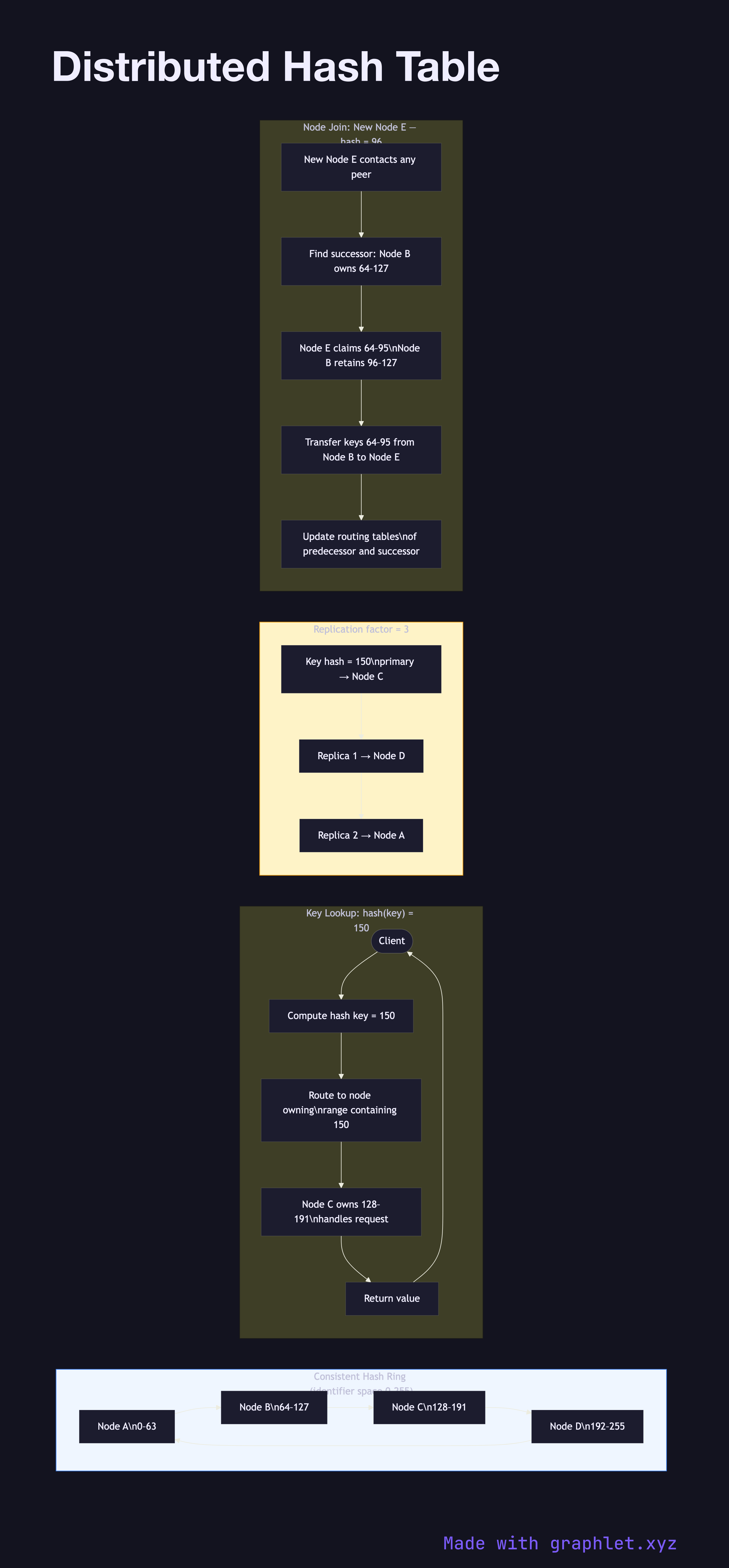
DHTs assign each node and each key a position in a common identifier space (typically 160-bit SHA-1 or 256-bit SHA-256 hashes). Each node is responsible for keys whose hash falls within a contiguous range of that space. When a node joins or leaves, only a fraction of keys — proportional to 1/N — must be remapped.

Key Routing: To look up a key, a node computes hash(key) and forwards the request toward the node responsible for that hash region. Different DHT algorithms achieve this with different routing tables: Chord Protocol uses a finger table enabling O(log N) hops; Kademlia uses XOR distance; Pastry uses prefix routing.

Replication: Keys are typically replicated to the next r successor nodes (commonly r = 3), so the data survives up to r − 1 simultaneous node failures. Read and write quorums follow the same W + R > N logic used by systems like Dynamo and Cassandra.

Node Join: A new node contacts any existing member, computes its own ID, and asks to find its successor. It then transfers the key range it now owns from that successor and updates neighboring nodes' routing tables. Membership changes propagate via Gossip Protocol.

DHTs underpin BitTorrent (Kademlia), IPFS (Kademlia), Cassandra (consistent hashing ring), and Amazon DynamoDB. The combination of consistent hashing, replication, and decentralized routing makes DHTs a foundational building block for any large-scale key-value store.

Free online editor
Edit this diagram in Graphlet
Fork, modify, and export to SVG or PNG. No sign-up required.
Open in Graphlet →

Frequently asked questions

A distributed hash table is a decentralised data structure that spreads ownership of a key-value store across many nodes. Each node is responsible for a range of hash values, and any node can route a lookup to the correct owner in a small number of hops — with no central directory required.
Each key and node is assigned a position in a shared identifier space by hashing. To look up a key, a node computes the key's hash and forwards the request toward the node responsible for that hash region using a routing table. Algorithms like Chord use finger tables to converge in O(log N) hops; Kademlia uses XOR distance metrics.
Use a DHT when you need a fully decentralised, horizontally scalable key-value store with no single point of failure — for example, in peer-to-peer file sharing (BitTorrent, IPFS), decentralised name resolution, or as the routing layer beneath a large-scale NoSQL database.
The main challenges are churn (frequent node joins and departures that require routing table repairs), hot spots when many keys hash to the same narrow range, and replication lag during membership changes. Consistent hashing with virtual nodes mitigates hot spots; a successor list or replication factor of 3 provides durability during churn.
mermaid
flowchart LR subgraph Ring ["Consistent Hash Ring (identifier space 0–255)"] direction LR N0["Node A\n0–63"] N1["Node B\n64–127"] N2["Node C\n128–191"] N3["Node D\n192–255"] N0 --> N1 --> N2 --> N3 --> N0 end subgraph Lookup ["Key Lookup: hash(key) = 150"] C([Client]) --> R1[Compute hash key = 150] R1 --> R2[Route to node owning\nrange containing 150] R2 --> R3[Node C owns 128–191\nhandles request] R3 --> R4[Return value] R4 --> C end subgraph Replication ["Replication factor = 3"] K1[Key hash = 150\nprimary → Node C] --> K2[Replica 1 → Node D] K2 --> K3[Replica 2 → Node A] end subgraph Join ["Node Join: New Node E — hash = 96"] J1[New Node E contacts any peer] --> J2[Find successor: Node B owns 64–127] J2 --> J3[Node E claims 64–95\nNode B retains 96–127] J3 --> J4[Transfer keys 64–95 from Node B to Node E] J4 --> J5[Update routing tables\nof predecessor and successor] end style Ring fill:#eff6ff,stroke:#3b82f6 style Replication fill:#fef3c7,stroke:#f59e0b
Copied to clipboard