diagram.mmd — flowchart
Search Suggestion Engine flowchart diagram

A search suggestion engine generates query recommendations that guide users toward better-formed searches — extending autocomplete with semantic intent understanding, related-query suggestions, and behavioral co-click patterns.
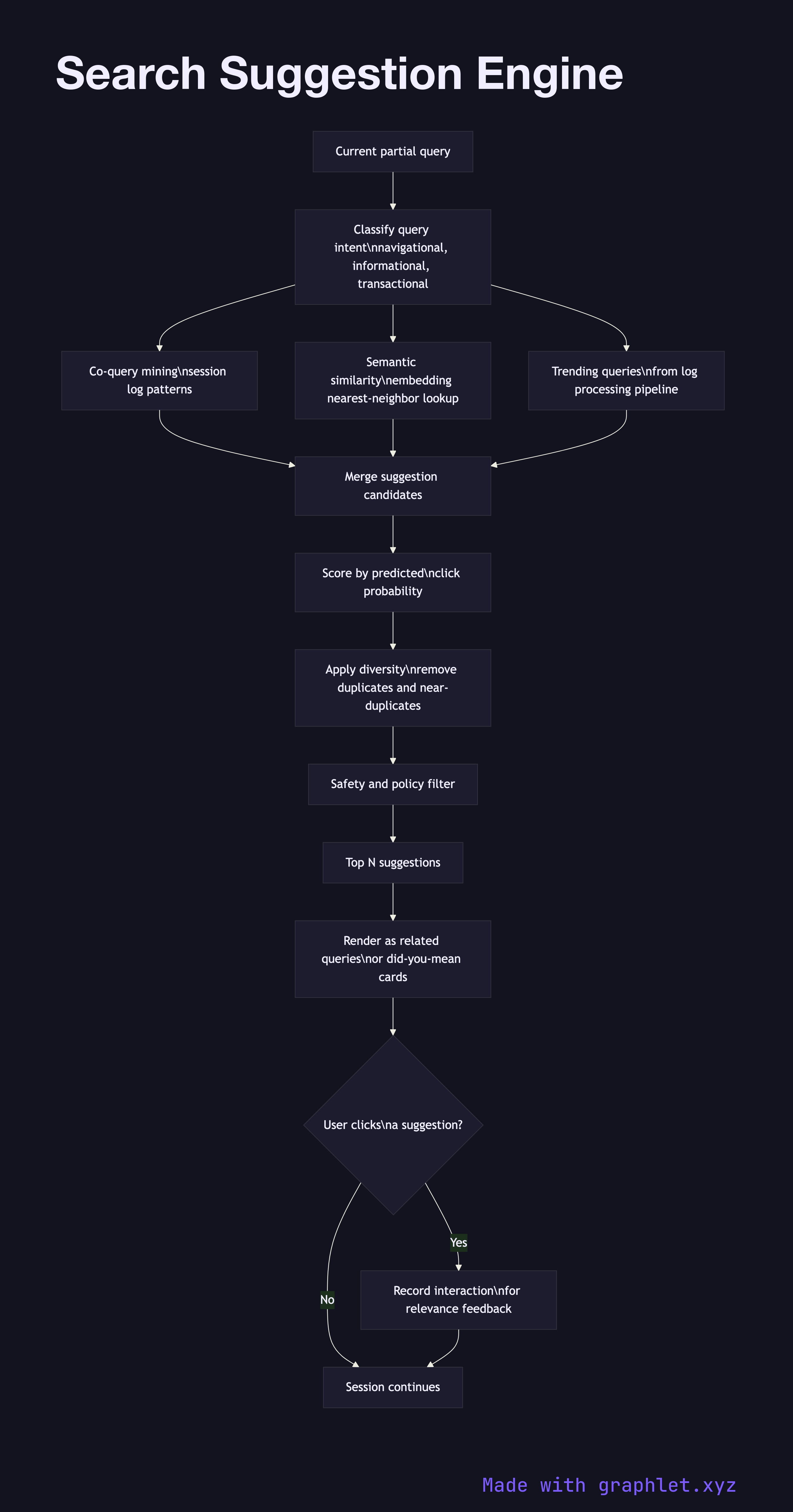
How the suggestion engine works

Input classification examines the current query to determine its type: navigational (the user wants a specific site), informational (the user wants to learn something), or transactional (the user wants to do or buy something). Classification shapes which suggestion strategies are applied.

Co-query mining analyzes historical session logs to find queries that users frequently issue in sequence or after reformulating a failed query. If many users who search "how to reverse a string python" next search "python string slicing", those two queries are co-query related and "python string slicing" becomes a candidate suggestion.

Semantic similarity uses dense vector embeddings to surface queries that are semantically related but lexically different. A query for "headache remedies" might yield suggestions like "migraine treatment" and "pain relief without medication" from a nearest-neighbor lookup in embedding space. This draws on the same embedding infrastructure described in Embedding Generation Flow.

Trending and seasonal signals boost suggestions that are currently experiencing elevated search volume, captured by the Search Log Processing pipeline. A trending topic that matches the user's query context will be surfaced prominently.

Candidate ranking merges suggestions from all sources and scores them by predicted click probability, estimated result quality, and diversity. The ranked list is filtered for safety and relevance before being returned.

Suggestion rendering presents the final set as "People also search for" cards, "Did you mean" corrections, or related-query links beneath search results. User interactions with suggestions feed back into the Search Relevance Feedback loop, continuously improving suggestion quality.

Free online editor
Edit this diagram in Graphlet
Fork, modify, and export to SVG or PNG. No sign-up required.
Open in Graphlet →

Frequently asked questions

A search suggestion engine generates query recommendations that help users discover better-formed searches. Unlike autocomplete, which completes a partial prefix in real time, a suggestion engine operates on complete or near-complete queries and surfaces related queries, intent-matched alternatives, and semantically similar searches using co-query mining and dense vector embeddings.
Co-query mining analyzes historical session logs to find queries that users issue in sequence within the same session — especially after reformulating a failed or unsatisfying search. Pairs or clusters of co-occurring queries are extracted, weighted by frequency, and stored in a graph. At runtime, the current query is looked up in the graph and its co-query neighbors become suggestion candidates.
Semantic similarity is valuable when lexical co-query patterns are sparse — for example, on a new platform without enough session history, or for long-tail queries that rarely co-occur with others. Embedding-based nearest-neighbor lookup can surface semantically related queries that share no keywords with the original, bridging vocabulary gaps that co-query mining cannot.
The most common mistake is treating suggestion as a synonym for autocomplete and using a simple prefix trie for both, which misses the intent-understanding and co-query capabilities that make suggestions useful. Other mistakes are not filtering suggestions for safety and relevance before rendering, and not feeding user interactions on suggestions back into the relevance loop to improve future suggestion quality.
mermaid
flowchart TD Query[Current partial query] --> Classify[Classify query intent\nnavigational, informational, transactional] Classify --> CoQuery[Co-query mining\nsession log patterns] Classify --> Semantic[Semantic similarity\nembedding nearest-neighbor lookup] Classify --> Trending[Trending queries\nfrom log processing pipeline] CoQuery --> Candidates[Merge suggestion candidates] Semantic --> Candidates Trending --> Candidates Candidates --> Rank[Score by predicted\nclick probability] Rank --> Diversity[Apply diversity\nremove duplicates and near-duplicates] Diversity --> Safety[Safety and policy filter] Safety --> TopN[Top N suggestions] TopN --> Render[Render as related queries\nor did-you-mean cards] Render --> UserInteract{User clicks\na suggestion?} UserInteract -->|Yes| FeedbackLoop[Record interaction\nfor relevance feedback] UserInteract -->|No| End[Session continues] FeedbackLoop --> End
Copied to clipboard