Multi Region Deployment
A multi-region deployment runs identical copies of a service in geographically separate data center regions, reducing latency for global users and providing disaster recovery if an entire region becomes unavailable.
A multi-region deployment runs identical copies of a service in geographically separate data center regions, reducing latency for global users and providing disaster recovery if an entire region becomes unavailable.
What the diagram shows
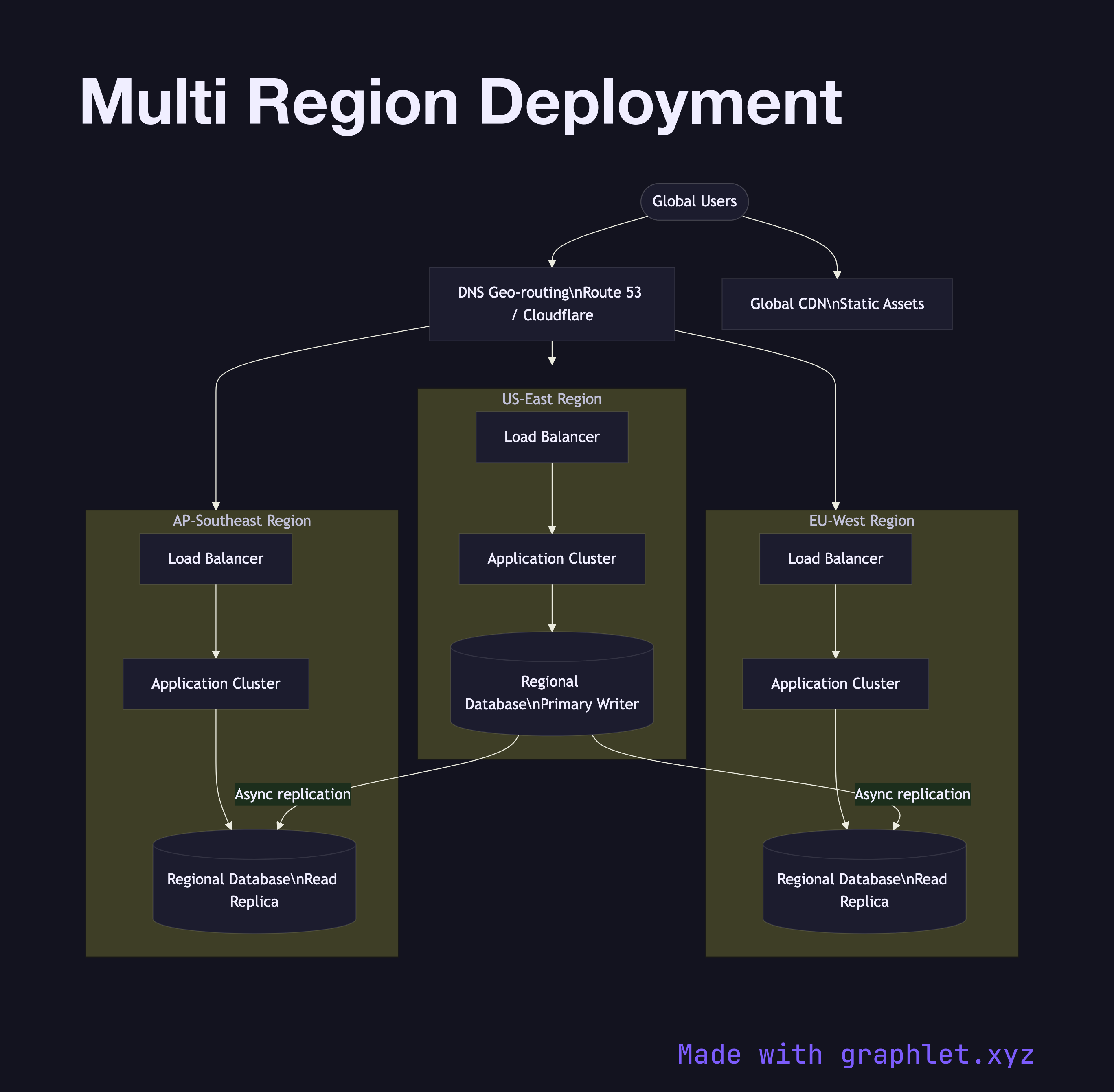
Global DNS with Geo-routing (e.g. AWS Route 53 latency routing or Cloudflare Load Balancing) directs each user to the nearest active region. The diagram shows three regions: US-East, EU-West, and AP-Southeast. Each region is a self-contained stack with its own Load Balancer, Application Cluster, and Regional Database.
The three regional databases form a Global Database Cluster using cross-region replication. One region is designated the primary writer; the others replicate asynchronously and can be promoted to primary during a regional failover. A Global CDN layer serves static content from edge locations worldwide, further reducing origin traffic.
Why this matters
Multi-region deployments reduce p99 latency dramatically — a user in Singapore hitting a Singapore region instead of US-East can see 200ms round-trip times drop to 30ms. They also provide geographic redundancy: if US-East fails entirely, DNS failover can redirect traffic to EU-West within seconds. The engineering cost is synchronizing state across regions — conflict resolution, replication lag, and distributed transactions are all harder problems at global scale. For single-region HA, see High Availability System. For failover procedures, see System Failover Architecture.