diagram.mmd — flowchart
AI Feedback Loop flowchart diagram

An AI feedback loop is the continuous cycle through which a deployed model collects real-world signals, monitors its own performance, detects degradation, and triggers retraining to maintain or improve accuracy over time.
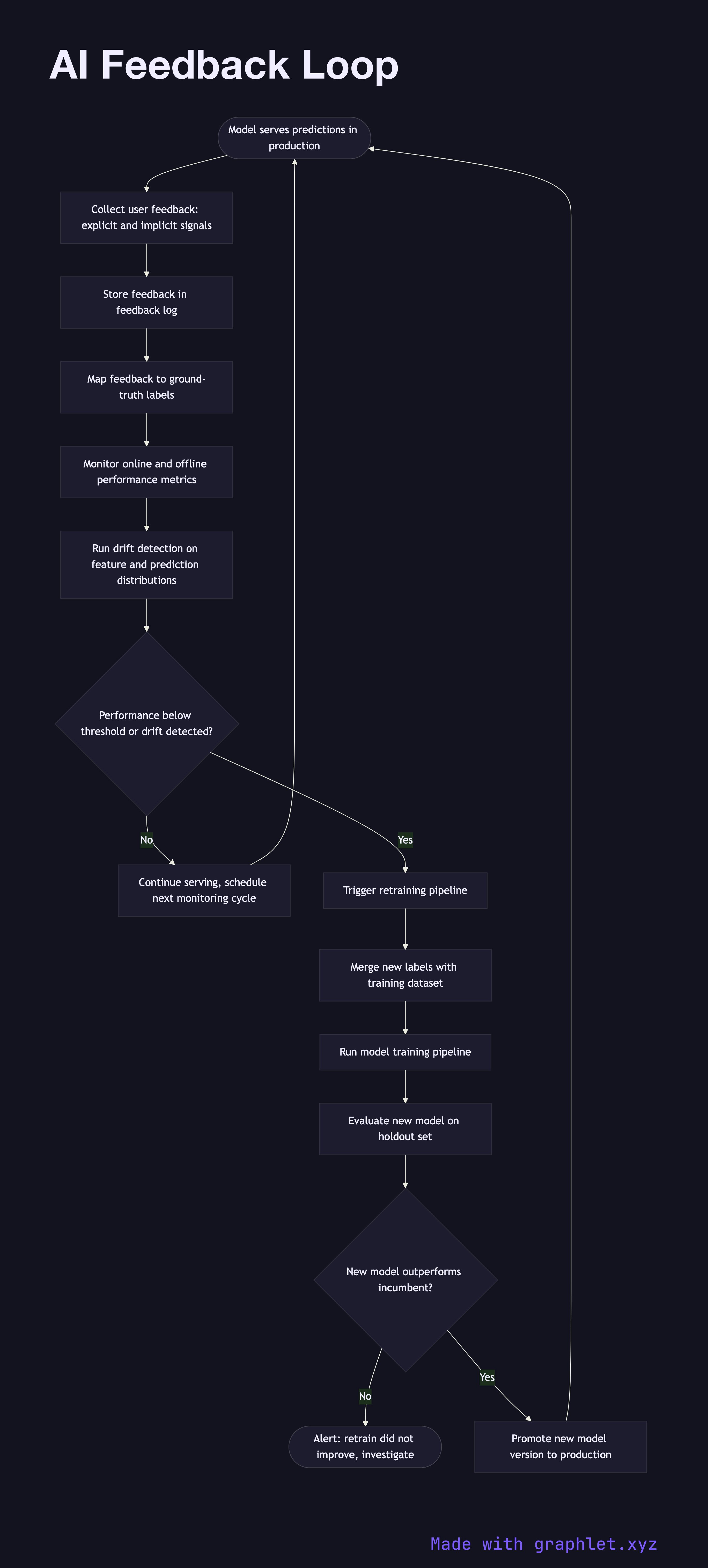
What the diagram shows

This flowchart maps the closed-loop lifecycle that keeps a production ML system healthy:

1. Model serves predictions: the deployed model generates predictions in response to live requests (see Inference Pipeline). 2. Collect user feedback: explicit feedback (thumbs up/down, ratings, corrections) and implicit signals (clicks, purchases, dwell time) are captured and stored in a feedback log. 3. Label collection: for supervised learning, feedback signals are mapped to ground-truth labels. Implicit signals may go through a labeling pipeline or human review. 4. Monitor model performance: online metrics (click-through rate, conversion rate, rejection rate) and offline metrics are continuously tracked and compared against baseline. 5. Drift detection: statistical tests (PSI, KL divergence, population stability index) flag significant shifts in input feature distributions or prediction distributions. 6. Threshold check: if performance metrics fall below a defined threshold or drift is detected, a retraining trigger is fired. 7. Retrain trigger: the feedback labels are merged with the existing training dataset and a new training run is kicked off (see Model Training Pipeline). 8. Evaluate and promote: the newly trained model is evaluated against holdout data. If it outperforms the incumbent, it is promoted to production (see Model Version Deployment). 9. Loop continues: the promoted model serves new predictions, and the cycle repeats.

Why this matters

Without a feedback loop, model performance silently degrades as the real world drifts away from the training distribution. Automating this cycle is the foundation of MLOps and continuous learning systems.

Free online editor
Edit this diagram in Graphlet
Fork, modify, and export to SVG or PNG. No sign-up required.
Open in Graphlet →

Frequently asked questions

An AI feedback loop is the continuous cycle through which a deployed model collects real-world signals — explicit ratings, implicit engagement, and ground-truth labels — monitors its own performance metrics, detects degradation or data drift, and triggers automated retraining and redeployment to maintain accuracy over time.
Feedback signals (clicks, corrections, ratings) are collected from live predictions and mapped to ground-truth labels. A drift detector runs statistical tests on incoming feature and prediction distributions. When metrics fall below threshold, the labeled feedback data is merged with the existing training set and a new training run is triggered automatically, producing an updated model that is evaluated before promotion.
Automate the loop when your model faces non-stationary data — user behaviour, language patterns, or market conditions that shift over time. Manual retraining is acceptable for stable domains with infrequent updates, but any high-traffic production model with evolving data distributions benefits from continuous retraining to avoid silent accuracy degradation.
Common pitfalls include survivorship bias in feedback labels (only collecting signals from items the model already ranked highly), feedback delay (labels arrive days after predictions, creating stale training data), reward hacking (optimising for easily measurable proxies that diverge from actual quality), and runaway retraining loops (new models that are worse than their predecessors being auto-promoted without sufficient evaluation gates).
mermaid
flowchart TD A([Model serves predictions in production]) --> B[Collect user feedback: explicit and implicit signals] B --> C[Store feedback in feedback log] C --> D[Map feedback to ground-truth labels] D --> E[Monitor online and offline performance metrics] E --> F[Run drift detection on feature and prediction distributions] F --> G{Performance below threshold or drift detected?} G -- No --> H[Continue serving, schedule next monitoring cycle] H --> A G -- Yes --> I[Trigger retraining pipeline] I --> J[Merge new labels with training dataset] J --> K[Run model training pipeline] K --> L[Evaluate new model on holdout set] L --> M{New model outperforms incumbent?} M -- No --> N([Alert: retrain did not improve, investigate]) M -- Yes --> O[Promote new model version to production] O --> A
Copied to clipboard