AI Recommendation System
An AI recommendation system personalizes content, product, or media suggestions for individual users by combining collaborative filtering (what similar users liked), content-based signals (item attributes), and contextual ranking — served in real time with low latency.
An AI recommendation system personalizes content, product, or media suggestions for individual users by combining collaborative filtering (what similar users liked), content-based signals (item attributes), and contextual ranking — served in real time with low latency.
What the diagram shows
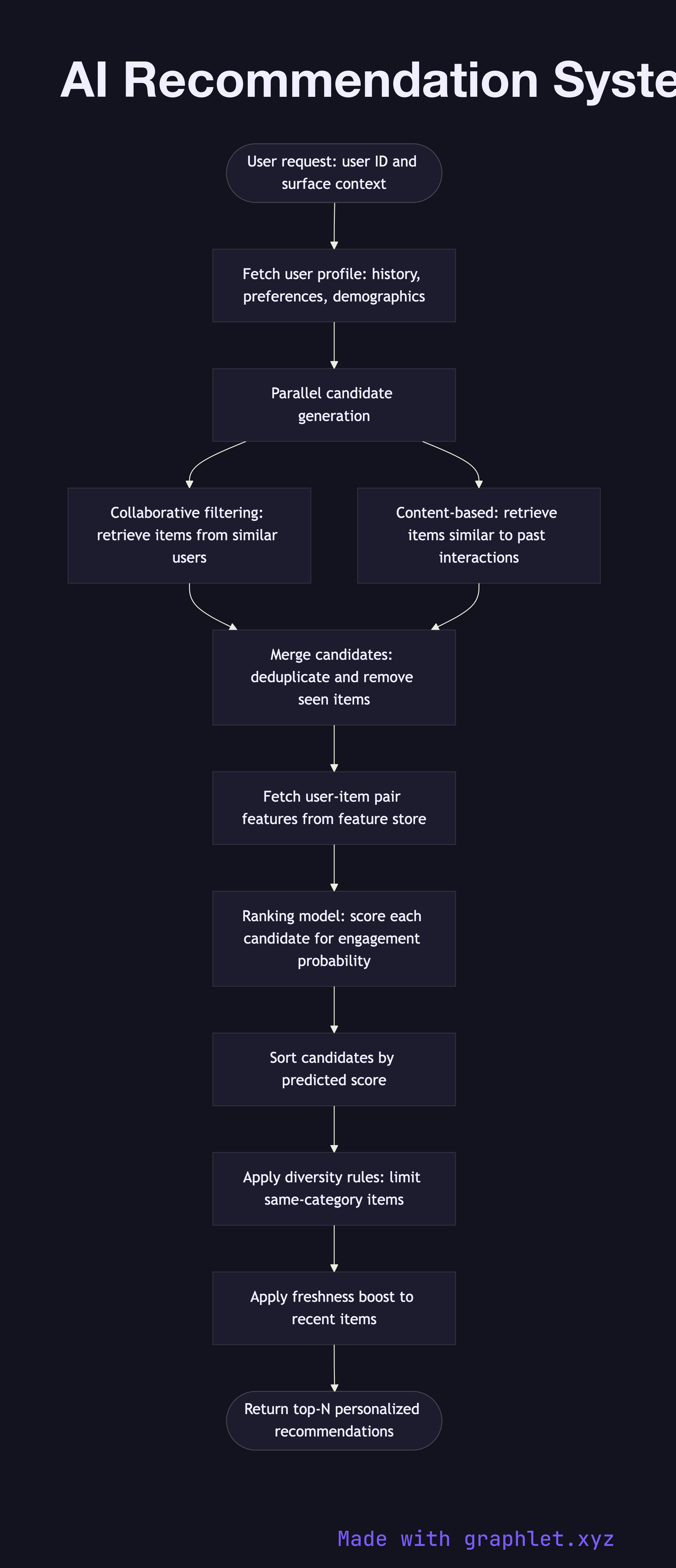
This flowchart maps the full recommendation serving path from user request to displayed recommendations:
1. User request: a recommendation surface (homepage feed, "you might also like" widget) fires a request with the user's ID and session context. 2. User profile lookup: the system fetches the user's historical interactions, preferences, and demographic features from the user profile store. 3. Candidate generation — collaborative filtering: an embedding-based CF model (matrix factorization, two-tower neural network) retrieves items similar to those the user and similar users have engaged with (see Embedding Generation Flow). 4. Candidate generation — content-based: item attribute embeddings are used to surface items similar in content to the user's past interactions. 5. Candidate merge: results from both retrieval paths are merged into a unified candidate pool, deduplicating seen items. 6. Feature engineering: user-item pair features are computed or fetched from the feature store for each candidate (see Feature Engineering Pipeline). 7. Ranking model: a personalized ranking model scores each candidate for predicted engagement probability (see AI Ranking Pipeline). 8. Diversity and freshness rules: business logic injects novelty — ensuring the user doesn't see the same top items every session — and applies freshness boosts to recent content. 9. Final recommendations: the ranked, diversified list is returned to the UI for display.
Why this matters
Recommendation systems drive a significant fraction of engagement and revenue in e-commerce, streaming, and social platforms. The two-stage architecture — fast candidate generation followed by accurate ranking — is the production standard because it balances personalization quality with sub-100ms serving latency.