diagram.mmd — flowchart
Distributed Task Scheduling flowchart diagram

Distributed task scheduling is the process by which a cluster manager assigns units of work (tasks, jobs, or containers) to worker nodes, managing resource constraints, priorities, failure recovery, and load balancing across a pool of heterogeneous machines.
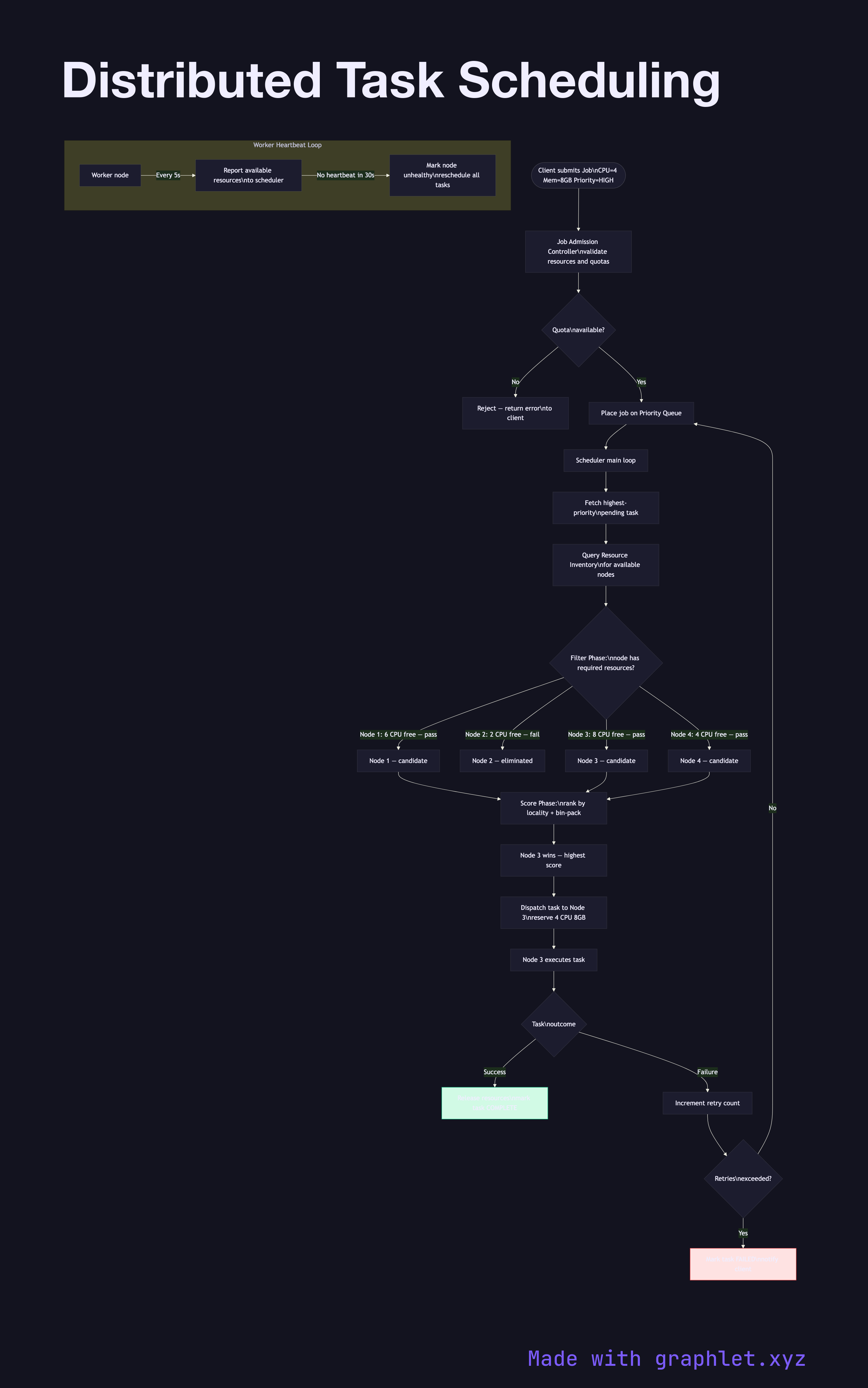
Modern distributed schedulers operate in a continuous control loop: accept job submissions, match tasks to available resources, dispatch work, monitor execution, and reschedule failed tasks — all without a single point of failure.

Job Submission and Queueing: Clients submit jobs with resource requirements (CPU, memory, GPU), priority, and dependency constraints. A job admission controller validates the request and places it on a priority queue. Dependency-aware schedulers (like Apache Airflow's DAG executor) will not schedule a task until all its upstream dependencies have successfully completed.

Resource Tracking: Worker nodes periodically report their available resources (heartbeat) to the scheduler. The scheduler maintains a resource inventory, tracking both total and currently allocated capacity. Kubernetes uses an informer-based watch mechanism rather than polling to keep this state consistent.

Task Placement: The scheduler selects candidate nodes by filtering (does the node have sufficient resources?) and then scoring (which candidate is optimal for locality, bin-packing, or spreading?). Algorithms range from simple round-robin and least-loaded to bin-packing (Tetris, Google Borg) and fair-share (YARN's DRF).

Failure Handling: If a worker node stops sending heartbeats, all tasks on that node are re-queued and rescheduled. Idempotent tasks can be speculatively executed on a second node in parallel (Hadoop's speculative execution) to reduce tail latency. See MapReduce Execution for how batch task graphs execute under this scheduler, and Cluster Coordination Architecture for how the scheduler itself achieves high availability.

Free online editor
Edit this diagram in Graphlet
Fork, modify, and export to SVG or PNG. No sign-up required.
Open in Graphlet →

Frequently asked questions

Distributed task scheduling is the process by which a cluster manager assigns units of work to worker nodes while respecting resource constraints, priorities, and dependency relationships. The scheduler continuously tracks available capacity, places new tasks, and reschedules work from failed nodes — all without a single point of failure.
Worker nodes report their available resources via periodic heartbeats. The scheduler maintains a resource inventory and, when a task is submitted, filters nodes that meet requirements and scores the remaining candidates using policies like bin-packing or least-loaded. The winning node receives the task assignment and begins execution.
Use a distributed task scheduler whenever work exceeds the capacity of a single machine and must be spread across a pool of workers — batch data pipelines, machine learning training jobs, container orchestration, and continuous integration all rely on schedulers. Kubernetes handles containerised services; Apache Airflow handles DAG-based workflow dependencies.
Common pitfalls include not making tasks idempotent (causing incorrect results on retry after failure), setting resource requests too low (leading to noisy-neighbour interference), not implementing back-pressure on the job queue (causing the scheduler to become a bottleneck), and failing to handle partial failures in a multi-step DAG gracefully.
mermaid
flowchart TD A([Client submits Job\nCPU=4 Mem=8GB Priority=HIGH]) --> B[Job Admission Controller\nvalidate resources and quotas] B --> C{Quota\navailable?} C -->|No| D[Reject — return error\nto client] C -->|Yes| E[Place job on Priority Queue] E --> F[Scheduler main loop] F --> G[Fetch highest-priority\npending task] G --> H[Query Resource Inventory\nfor available nodes] H --> I{Filter Phase:\nnode has required resources?} I -->|Node 1: 6 CPU free — pass| J[Node 1 — candidate] I -->|Node 2: 2 CPU free — fail| K[Node 2 — eliminated] I -->|Node 3: 8 CPU free — pass| L[Node 3 — candidate] I -->|Node 4: 4 CPU free — pass| M[Node 4 — candidate] J --> N[Score Phase:\nrank by locality + bin-pack] L --> N M --> N N --> O[Node 3 wins — highest score] O --> P[Dispatch task to Node 3\nreserve 4 CPU 8GB] P --> Q[Node 3 executes task] Q --> R{Task\noutcome} R -->|Success| S[Release resources\nmark task COMPLETE] R -->|Failure| T[Increment retry count] T --> U{Retries\nexceeded?} U -->|No| E U -->|Yes| V[Mark task FAILED\nnotify client] subgraph Heartbeat ["Worker Heartbeat Loop"] W[Worker node] -->|Every 5s| X[Report available resources\nto scheduler] X -->|No heartbeat in 30s| Y[Mark node unhealthy\nreschedule all tasks] end style S fill:#d1fae5,stroke:#10b981 style V fill:#fee2e2,stroke:#ef4444
Copied to clipboard